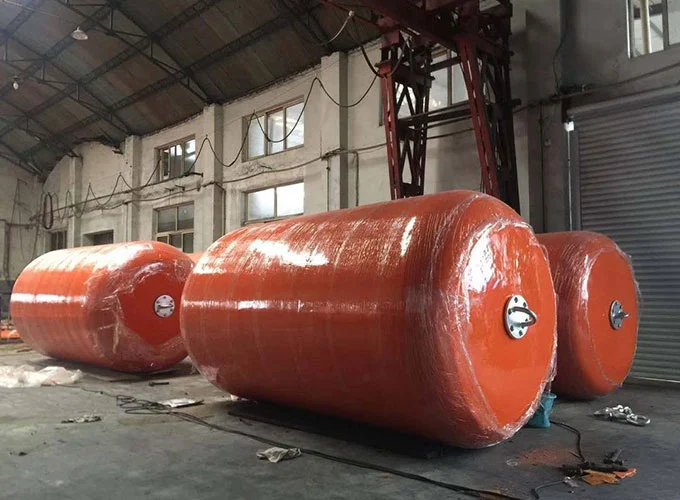
Complex concrete construction increasingly involves hollow sections, curved profiles, irregular cavities, and components with restricted internal access. These geometries create challenges for conventional formwork, particularly when internal molds must maintain dimensional accuracy during concrete placement and be removed after curing. Inflatable rubber core technology offers an alternative forming method for selected applications by combining a flexible structure with controlled expansion and deflation.
The effectiveness of this approach depends on more than the flexibility of the mold itself. Mold geometry, internal pressure, reinforcement arrangement, concrete placement, and demolding conditions all influence the quality of the finished component.
Traditional internal formwork commonly uses steel, timber, or rigid polymer components. These materials can provide stable geometric support, but complicated cavity profiles may require multiple sections, additional connections, or dedicated removal procedures. The difficulty increases when the finished concrete component has a narrow opening, a curved internal passage, or a cavity that extends through a long structural section.
For precast hollow slabs, bridge components, concrete culverts, and other reinforced concrete elements, the internal mold must retain its intended shape against the forces generated during casting. It must also remain correctly positioned as fresh concrete is placed and consolidated around it.
A rigid mold may require sufficient clearance for extraction, which can limit the geometry of the finished cavity. A flexible inflatable core can instead be deflated to reduce its cross-section before removal. This changes the demolding process and may simplify access to cavities that are difficult to reach with conventional rigid tooling.
However, flexibility does not eliminate the need for structural control. The mold must resist deformation, displacement, and excessive compression throughout the forming cycle.
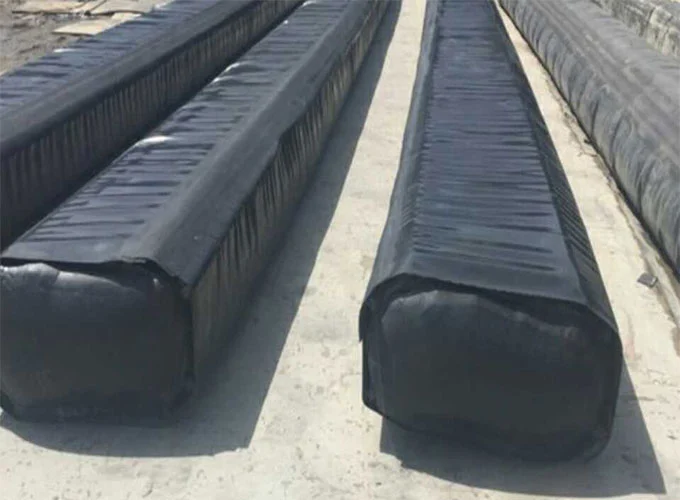
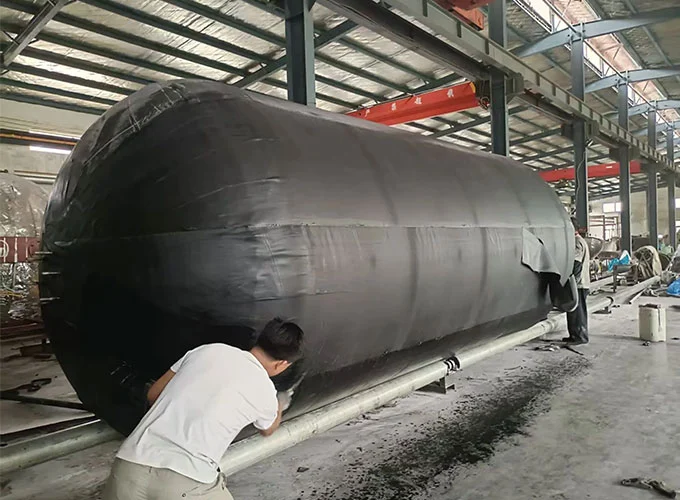
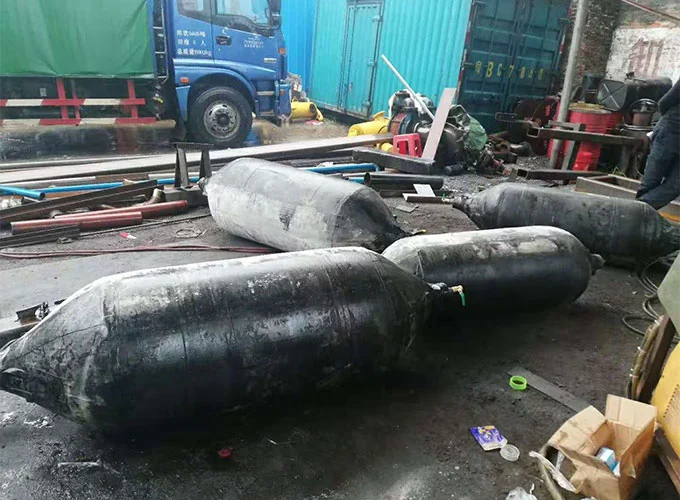
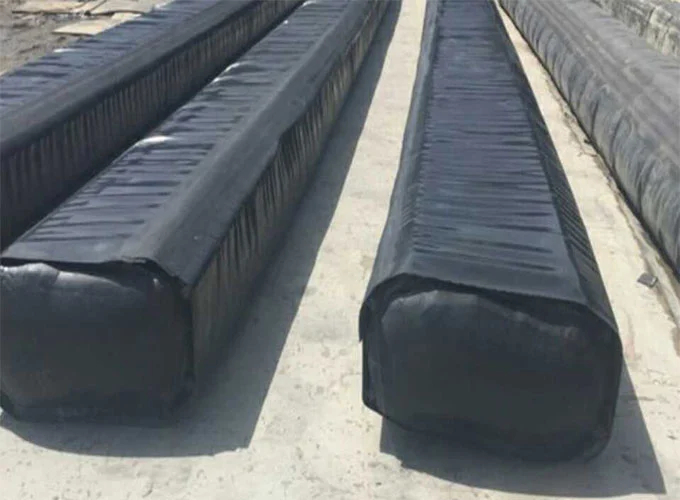
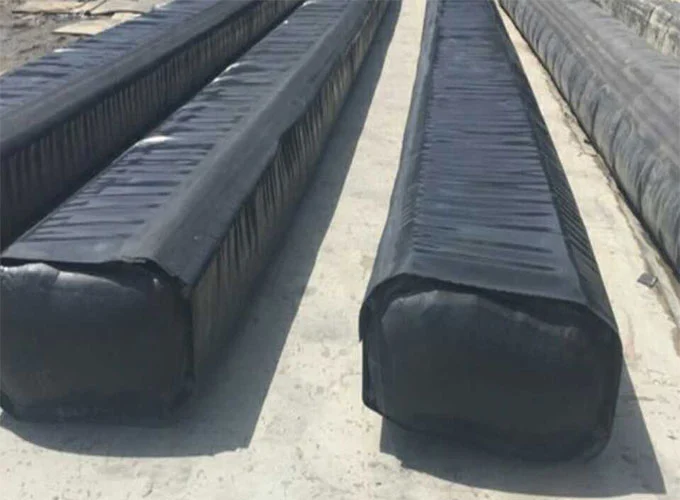
A Rubber Inflatable Core Mold forms an internal cavity by expanding within the surrounding reinforcement assembly before concrete placement. Once inflated to its specified working dimensions, the mold provides a temporary internal boundary that helps define the shape of the cavity.
Its flexible construction can be useful for selected curved, elongated, or irregular profiles where a collapsible internal form offers practical removal advantages. Depending on the mold design, the system can be positioned before inflation, allowing installation within a restricted space that would be less accessible to a fully expanded core.
The final geometry depends on the relationship between the mold's original dimensions, its material properties, internal pressure, and the external forces acting on it. Uneven expansion may produce variations in cavity width or cross-sectional shape. For this reason, the intended profile must be considered during mold design rather than corrected solely through inflation adjustments at the construction site.
The distinction between geometric flexibility and dimensional accuracy is important. A flexible mold can accommodate certain shapes, but it must still be engineered to maintain the required dimensions under actual casting conditions.
Fresh concrete exerts pressure on internal formwork, and the distribution of that pressure changes with placement depth, concrete consistency, and the sequence of pouring. Buoyancy can also cause an inflatable core to move upward if the mold is not adequately restrained.
These forces become particularly important in large or deep concrete sections. Insufficient internal pressure may allow local deformation, while excessive pressure can place unnecessary stress on the rubber body and its connections. Neither condition should be addressed through arbitrary pressure adjustments.
Engineering assessments of inflatable cores for large-diameter concrete culverts have identified resistance to concrete pressure, buoyancy, and deformation fatigue as important design considerations. Patent documentation describes structural support arrangements intended to improve shape retention under these conditions. Such designs illustrate the engineering challenges involved, although their specific configurations are not universal requirements for every inflatable core.
Practical control measures include securing the mold against displacement, monitoring inflation pressure, coordinating the concrete placement sequence, and applying an appropriate consolidation method. The working pressure and restraint arrangement should be established for the individual mold and concrete component.
Rubber formulation and reinforcement construction influence how an inflatable core responds to repeated expansion, external loading, and handling. The material must maintain sufficient flexibility for installation and extraction while providing the dimensional stability required during casting.
Wall thickness, reinforcement layers, joint construction, and valve design can all affect performance. Localized thinning, surface damage, or inconsistent expansion may change the mold's response to pressure and increase the likelihood of dimensional variation.
Surface condition also matters when the mold contacts fresh concrete. Damage, contamination, or accumulated residue can interfere with handling and cleaning, while repeated folding and inflation may gradually affect the material. Pre-use inspection should therefore examine the rubber body, seams, connections, and inflation components.
For complex forming applications, Rubber Inflatable Core Mold selection should be based on the required cavity geometry, working pressure, expected external loads, and intended service conditions. Material flexibility alone is not a sufficient measure of suitability.
The installation sequence has a direct influence on forming accuracy. The mold must fit within the reinforcement cage without interfering with the designed concrete cover or displacing reinforcement during inflation. Positioning and restraint should also account for the forces that develop as concrete is placed around the core.
Concrete placement should be sufficiently controlled to avoid uneven loading and unwanted movement. Excessive or poorly distributed vibration may affect the mold's position, while inconsistent filling can contribute to differences in pressure around its surface. The concrete mix, placement rate, reinforcement arrangement, and consolidation procedure should therefore be planned as part of one forming process.
Demolding requires similar coordination. The concrete must reach the specified release condition before the mold is deflated and removed. Removing it too early can damage cavity surfaces or edges; an unsuitable extraction path can also cause unnecessary friction or handling stress.
The available access opening should be incorporated into the original design. For curved or elongated cavities, the deflated mold must be able to collapse sufficiently and pass through the intended removal route without damaging the concrete component.
The quality of a complex concrete cavity cannot be judged by the appearance of the mold alone. Inspection of the finished component may include cavity dimensions, wall thickness, alignment, surface condition, and conformity with engineering drawings.
Before each use, the mold should be examined for visible damage and checked according to the manufacturer's specified pressure-retention and inspection procedures. After use, cleaning and storage practices can help limit abrasion, contamination, and deterioration associated with repeated handling.
Reuse may reduce the need to fabricate a new internal mold for every production cycle, but the number of usable cycles depends on material construction, operating conditions, maintenance, and inspection results. A consistent record of pressure settings, observed deformation, repairs, and service history can help identify changes in performance over time.
These controls are especially relevant to repeated precast production, where dimensional consistency across multiple components is an important quality objective.
Inflatable rubber cores are not a universal replacement for rigid formwork. Steel and other rigid systems remain appropriate where their structural support, surface finish, or dimensional characteristics best match the application. Inflatable cores are more relevant when flexible installation, collapsible removal, and the geometry of an internal cavity create a clear technical advantage.
For bridge components, culverts, hollow precast elements, and specially designed concrete members, the decision should consider cavity shape, structural requirements, production volume, access for demolding, and the forces expected during casting.
The contribution of Rubber Inflatable Core Mold technology to complex concrete forming lies in the way flexibility can be combined with pressure control and a planned removal sequence. Its performance depends on the coordination of mold design, rubber material properties, reinforcement placement, concrete handling, and inspection.
As concrete construction continues to accommodate more varied geometries, the most useful forming methods will be those that address specific engineering constraints while maintaining measurable control over dimensional accuracy and finished-component quality. Inflatable core systems provide one option within this broader development of adaptable concrete forming technology.
-
Phone: +86-532-87511707
Mobile: +86-13697683983
Email: anny@ardfenders.com
Address:No. 60, Kongquehe Fourth Road, Clothing Industrial Park, Jimo District, Qingdao City, Shandong Province, China
Copyright © 2026 Qingdao Aorunda Rubber Industry Co., Ltd. All rights reserved.